

For decades, becoming a “trusted advisor” was the pinnacle of the attorney-client relationship. Once clients truly trust their lawyers and believe in their judgment, they are more likely to consider and follow their counsel. Lawyers often have to deliver news their clients do not want to hear or suggest strategies that may initially seem off course. As trusted advisors, they earn the credibility required to deliver hard truths.
This remains genuinely valuable. The traditional trusted advisor model, however, is fundamentally built around advice. The client encounters a question or problem, recognizes the need for assistance, reaches out to a lawyer, and receives an accurate, thoughtful response. The onus remains on the client to identify the need, formulate the question, and initiate the engagement.
Things are changing. There is a significant shift happening that may challenge the trusted advisor vernacular and the overall mindset surrounding client service. The next level of client service requires moving beyond the responsive, question-and-answer framework toward advocacy, activation, and a different kind of client support.
What does it mean to evolve from Trusted Advisor to become a Trusted Advocate?
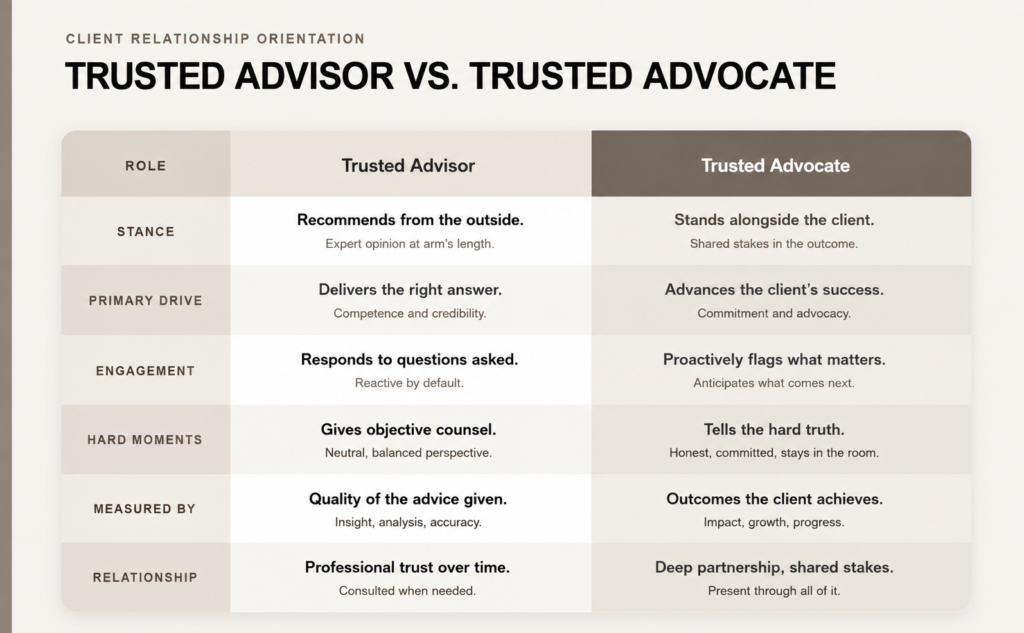
A trusted advocate brings all the skill, expertise, and honest judgment of a trusted advisor, and yet the orientation of the relationship flips. The trusted advisor’s primary focus is delivering the right answer. The trusted advocate’s North Star is the client’s outcomes and success.
Trusted advocates do more than advise. They are there to move for the client, fight for the client, help the client see around corners, protect the client’s business goals, and to always have the client’s back.
The Core Shift: From Outside-In to Inside-Out
This shift isn’t merely wordsmithing. A trusted advisor traditionally operates from the responsive vantage point or “outside-in.” They are the expert brought into a situation to provide an informed, independent perspective. Their credibility hinges on being right, which can sometimes mean hedging, remaining neutral, or stepping back when a situation becomes especially complicated or messy.
In the trusted advocate role, the lawyer stands alongside the client with an “inside-out” vantage point. They are still expected to exercise independent judgment and deliver the hard truth. The difference is the position from which that truth is delivered. Instead of simply saying, “Here is my assessment,” the advocate says, “Here is what we are facing, and here is how we are going to get through it.”
The role shift does not diminish expertise or objectivity; it shifts perspective. It demonstrates commitment, solidarity, and a shared stake in the client’s outcomes.
For lawyers, this idea should feel both familiar and important. Advocacy is at the heart of what lawyers are trained to do. Yet somewhere along the way, the professional services emphasis on becoming a trusted advisor may have softened that instinct. Lawyers can proactively help clients advance their businesses, anticipate risks, recognize opportunities, navigate hard moments, and protect what their clients are working to achieve. Advocacy is about advancing a client’s cause and business interests continuously rather than episodically.
Where Trusted Advocacy Creates Distinctive Value
The difference between advising and advocating becomes especially clear in three situations:
In Hard Moments
When a client faces a crisis, makes a questionable decision, or finds itself in conflict, a trusted advisor provides balanced counsel and an independent assessment of the risks.
A trusted advocate does that too, and physically and metaphorically stays in the room. Advocates do not tell clients only what they want to hear; they work through challenges together and tell them the hard truth in a way that they can hear it. An advocate who avoids difficult conversations is not an advocate; they are a flatterer. Genuine advocacy requires the courage to challenge a client, identify the risks, and deliver an uncomfortable truth when necessary.
The difference lies in how that counsel is framed and what happens next. A trusted advocate does not stop at identifying the problem and listing solutions. They are part of the client’s brain trust and are relied upon to help the client navigate the situation and determine how to move toward the best possible outcome.
Through Proactivity
Traditional advisory relationships are largely pull-based. The client asks a question, identifies a need, or initiates an engagement. The advisor responds. Trusted advocates push: they proactively advance their clients’ interests.
They are thinking about the questions the client should be asking. They track what is happening in the client’s business and industry, recognize what may be coming two quarters from now, and raise it before the client requests help. This type of foresight communicates a vested interest in the client’s success.
For example, the advocate sees regulatory development, market shift, competitive threat, internal vulnerability, or emerging opportunity and brings it forward unprompted. They are not waiting for the client to connect the dots or determine when assistance is needed. They are already looking around the corner.
Through Presence Over Time
Advisory relationships can be one-off. The advisor is consulted when a specific matter arises, delivers valuable guidance, and steps away until the next need emerges.
Advocacy is continuous. The trusted advocate remains connected to the client’s world between formal touchpoints. They understand the larger business strategy, the people involved, the history behind important decisions, and the pressures influencing the client’s choices.
Each interaction builds on the last. The advocate develops context that cannot be easily understood by a new attorney. Over time, the relationship becomes deeper, more trusted, and more valuable because the advocate understands not only the client’s immediate question but also what the client is ultimately trying to accomplish and how they make decisions.
Trusted Advocacy in the Age of AI
The distinction between advisor and advocate becomes even more consequential as artificial intelligence changes how professional expertise is accessed and delivered. AI can synthesize information, identify issues, analyze data, draft documents, and produce possible answers with remarkable speed. Yet, answers are not the same as advocacy.
Advocacy requires more than analysis. It requires deep understanding. When information and analysis become increasingly accessible, the lawyer’s commitment, contextual understanding, initiative, judgment, and presence become even more meaningful. Clients do not simply need someone who can provide an answer. They need someone who can help them understand what the answer means, decide what to do next, and advance toward the outcome they are trying to achieve.
Advocacy Requires More
Trusted advocacy is not a replacement for genuine expertise or honest judgment. It requires more of both. Commitment without competence is not valuable. Neither is loyalty without authenticity. Real relationship power lies in combining deep competence with a genuine interest in the client’s outcomes. That combination is rare, which is exactly why clients who find it tend to hold onto it.
The trusted advisor model has served professional services well. Now is the time to take it up a notch and become your client’s trusted advisor AND their trusted advocate.